CodeNSolder
Hard times create strong men, strong men brings good times, good time creates weak men, weak men brings hard times
I write code, blog posts and talks, and an AI agent can now draft all three.
At the end of part 1 I said “I don’t see any great edge I have over AI in the next three to five years if it keeps growing at this pace”, wrote myself a list of skills to work on, and left the harder question for later. This is later.
Part 1 was me looking at the world economy the way I look at a system I’ve built. I found a design with no slack, and I stopped at labour: “AI is the next source of cheaper labour, and this time the work doesn’t go to another country’s workers. It moves to agents”
So here are the three questions I left hanging. What happens to people, me included, when the work goes to machines? What stays human? And if a sixth extinction is coming for us, what does it look like?
I’ll tell you where I ended up, so you can argue with me on the way. If a catastrophe comes, I think we’ll most likely cause it ourselves, it’ll move through many systems at once, and AI will be the strongest amplifier. I also don’t think the outcome is fixed, because this time the cause can read the warning.
I also somewhat believe the 1 scenario where Humans have to ultimately merge with AI for survival - a kind of symbiosis, a deal where if one party tries to take down the other, both come crashing down. A toxic mutualism where survival is a function of cooperation by design. But that could be way beyond my lifetime.
Five extinctions, and we missed all of them
Palaeontologists count five mass extinctions since life bloomed on earth, each one taking out more than three-quarters of species in a short time on the geological clock. The last was 66 million years ago and never one involved humans. The causes were planetary: an asteroid, huge volcanic eruptions, changes in climate and in the chemistry of the oceans, and scientists still argue about the details of some of them. In all five, whatever died had no way to read the warnings.
Part 1 mentioned that many biologists think a sixth has already started, with other species paying so far. My question is narrower and more selfish: can we build a disaster that size for ourselves, and what would it look like? When I say “sixth extinction” from here on I’m using it loosely, to mean a catastrophe for humans, and I don’t mean the loss of three-quarters of all species or maybe it does, after all humans are already responsible for so many extinct flora and fauna, polluting oceans, air and filling land and seabeds with plastics.
Jobs go first, and the gains come late
Every big technology destroys some jobs and creates others. Most arguments about AI and work stop at that sentence, and on its own I find it useless. When something I’ve built goes down, “it came back up eventually” isn’t the report I want. I want to know how long it was down and who was stuck while it was.
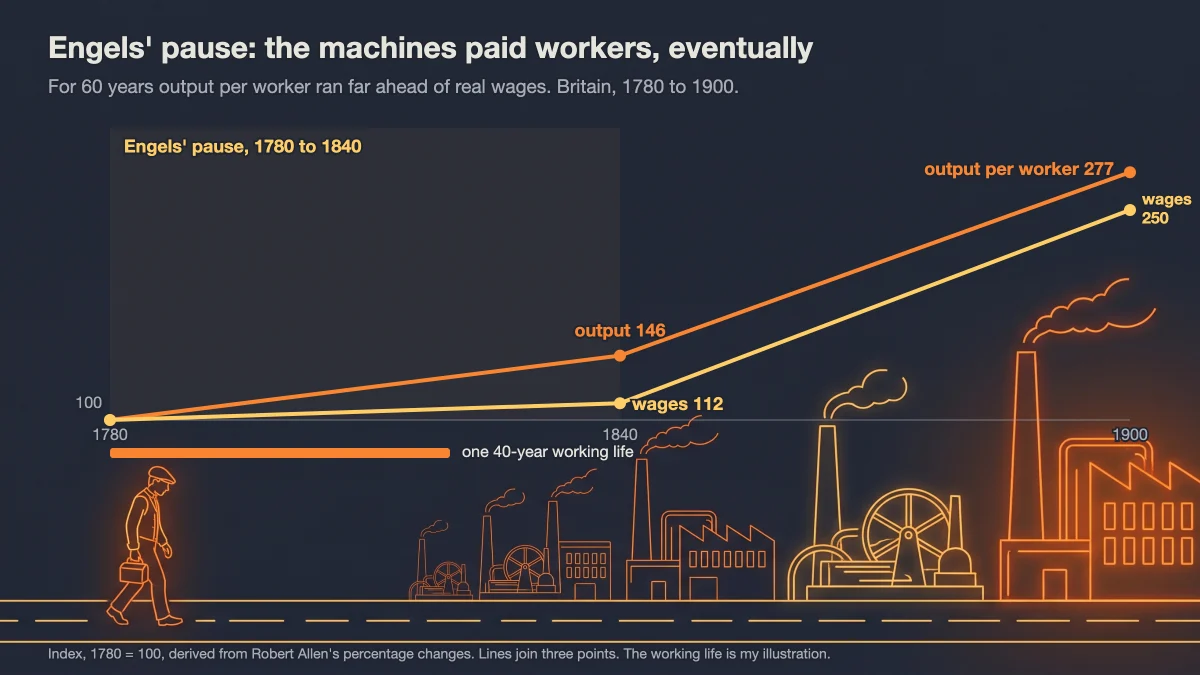
Britain is the best-known example, and it’s a delay in pay. On Robert Allen’s numbers, output per worker rose 46% between 1780 and 1840 while real wages rose 12%. He named that stretch “Engels’ pause”. From 1840 to 1900 it flipped: output per worker up 90%, real wages up 123%. So the machines did pay workers in the end. But if you started work in 1780, you could spend your whole working life inside the pause.
An Anthropic study from March 2026 however finds no systematic rise in unemployment YET, though it does find a 14% drop in the rate at which young workers enter exposed jobs, and it calls that barely significant.
So I can’t call this proof. It’s an early signal in one group of workers. But I wouldn’t ignore an early signal on a system I am responsible for, and this one sits at the door every career goes through.
I count myself in this. The data suggests experienced workers are safer for now, in the US at least, and I may be one of them. I can’t feel too good about that, because someone has to come through that door behind me.
Why I don’t trust UBI to fix this
There has been a lot of talk about Universal Basic Income framework, Elon talked about it on Joe Rogan Podcast, I guess even Sam Altman favours it. The idea seems simple - since most of the work will be done by AI, AI front companies will make all the revenue, tax them at 70-80% of rates and give citizens a Universal basic pay check.
I think it’s as stupid idea as the fix. Cash can stop poverty, but a job gives a person much more than money. UBI feels communism on steroids. I often feel I can retire but then I think what would I do with my time? There’s so many vinyl records I can listen to in a day or so. I could be on road travelling but I like solving problems and my job gives me a sense of satisfaction when I do that.
The social psychologist Marie Jahoda listed what a job gives you apart from the pay:
- a structure for the day
- contact with other people
- a shared purpose
- status
- regular activity
A monthly payment gives you none of these by itself. The closest thing to a warning I can find is Anne Case and Angus Deaton, who found that midlife deaths rose among white Americans with less education from the late 1990s. Drugs, alcohol and suicide drove much of the rise, and they named these “deaths of despair”.
I feel capitalism works because people inherently enjoy inequality, they like paying their way out to a fancier place or better experience which becomes a prime motivation for others to work hard / smart, solve problems and earn their place and status to enjoy the fineness of life, which UBI cannot solve for. Even if AI does everything, I expect people to find a creative way to sell something of their own.
What stays human
When AI makes output cheap, the things it can’t supply get scarce. I can see three.
The first is accountability, and my favourite case is small and a bit funny. In February 2024 a Canadian tribunal ruled against Air Canada after its website chatbot gave a customer wrong advice about bereavement fares. The tribunal wrote: “In effect, Air Canada suggests the chatbot is a separate legal entity that is responsible for its own actions. This is a remarkable submission.” It ordered the airline to pay $812.02.
If a device I’d shipped told someone the wrong thing, I wouldn’t get to call the firmware a separate legal entity either. The sum is small and the tribunal handles small claims, but the logic reaches further: the owner answers for the machine. The owner here was a company, so the case doesn’t prove that a person keeps a job.
There’s also a photo of an IBM slide, reportedly from internal training in 1979: “A computer can never be held accountable / Therefore a computer must never make a management decision.” A flood destroyed the original, so the date rests on the word of the person who found it. I like it anyway.
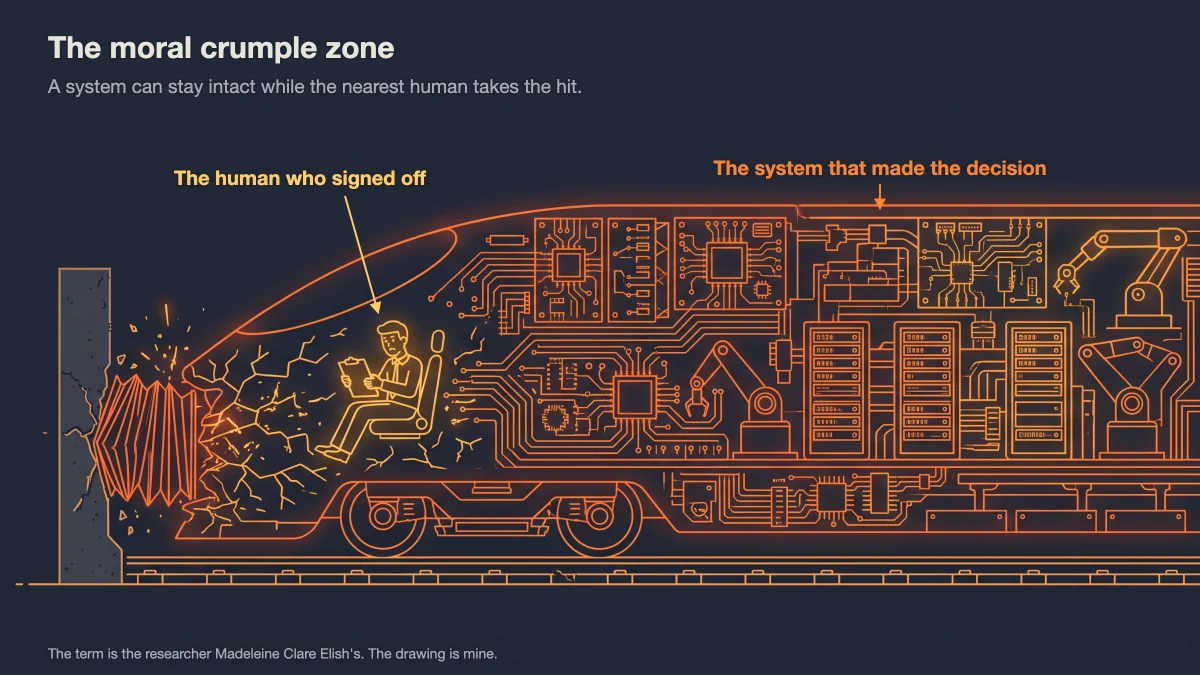
There are catches. One person can sign off the work of ten AI agents, so accountability may need one person where ten worked before. That one person can also end up carrying the blame for a system they had little control over, which the researcher Madeleine Clare Elish calls a “moral crumple zone”.
The Stanford data adds a nastier one. People learn judgement from junior work, so if firms stop hiring juniors, who signs off in 2045?
The second thing is the belief that a person cared. Start with the uncomfortable result. In a 2023 study in JAMA Internal Medicine, evaluators compared ChatGPT and doctors on 195 patient questions from a public forum, without knowing who wrote what. They rated 45.1% of the chatbot’s answers as empathetic or very empathetic, and 4.6% of the doctors’. Before you fire your doctor: the test favoured the chatbot, because the doctors were volunteers writing short forum replies.
Then change the label. In a 2025 paper in Nature Human Behaviour, researchers ran nine studies with 6,282 people where every response came from AI, and told some people that a human wrote it. Those people rated the responses as more empathic and more supportive. A PNAS paper found AI messages made people feel more heard, until they learned the source, and then they felt less heard.
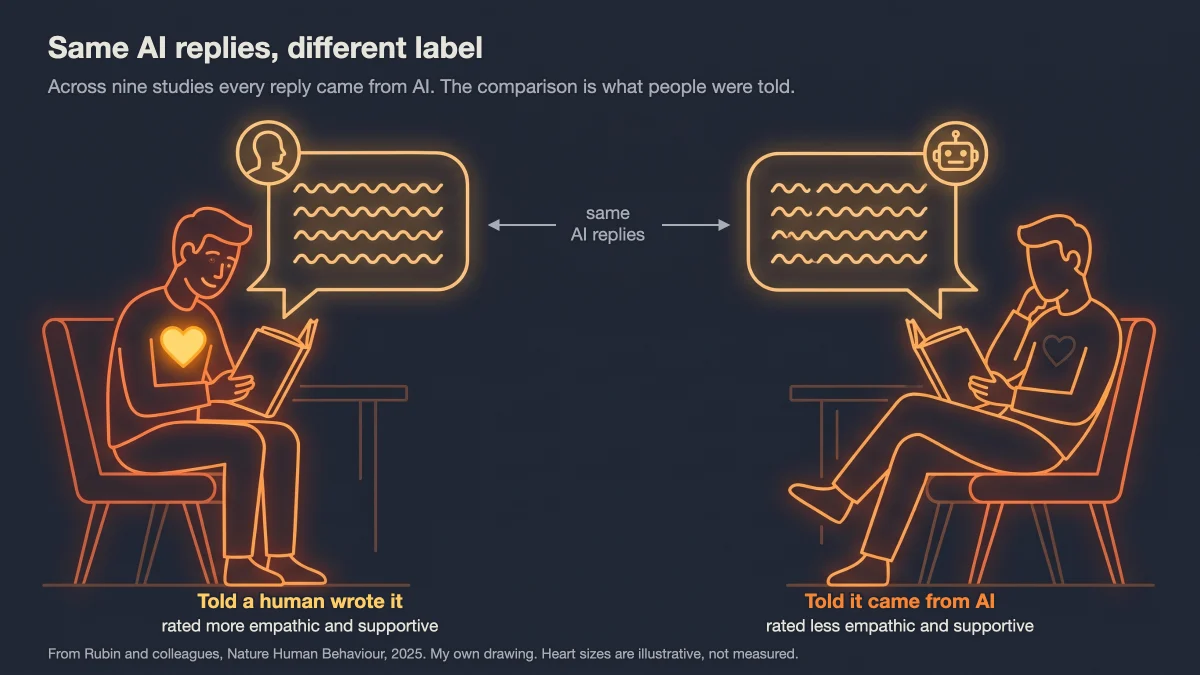
So the belief that a person cared carries much of the effect, and a false label can supply that belief too. Neither paper shows that time is the reason. My own guess is that the belief matters because a person has limited hours, and a machine doesn’t.
The third is a known human voice. I expect all that AI slop to raise the value of human produced content. I find myself gravitating more towards actual human opinions over an AI written LinkedIn post. Don’t how if it stays for long but I do feel this will be like the “Hand Made” , “Hand Crafted” stuff which could demand premium not because it’s better but someone actually customised it for an individual or a group who deeply cares about the topic or sub-culture.
When AI gets a body
The physical world still holds AI back, but that limit moves every year. Factories installed more than 600,000 industrial robots in 2025, and China took 59% of them. Humanoids are still small: analysts at Omdia and IDC put 2025 shipments at about 13,000 and 18,000 units, according to press reports. I guess Anthropic is also working on creating frameworks to let AI control the physical world with robotic structures. This only grows from here. A survey of 2,778 AI researchers ran in late 2023, and its combined forecast gave a 50% chance that machines beat humans at every possible task by 2047. The same survey put a 50% chance on full automation of all jobs only by 2116, so you can see how wide the guessing is.
When machines can also build and repair machines, AI may no longer need us. A 2023 statement from the Center for AI Safety says: “Mitigating the risk of extinction from AI should be a global priority alongside other societal-scale risks such as pandemics and nuclear war.” What would be the kill switch then? I wonder, or would power be still the bottleneck? Could AI figure out a way to extract more energy from the sun and level up the entire civilisation on Kardashev scale?
My own view is that survival may need a merger. By that I mean a dependence so deep that AI can’t survive without humans, an extreme form of mutualism.
Others use the word for something else. Sam Altman wrote: “I think a merge is probably our best-case scenario.” He meant electrodes or close friendship with a chatbot, and he didn’t mean AI that depends on us. The electrode version is at an early stage: Neuralink said in January 2026 that it had 21 people enrolled in its trials.
The strongest objection comes from biology, and it’s an ugly one. About two billion years ago a bacterium moved inside another cell and became the mitochondrion. Human mitochondrial DNA now holds 37 genes, and most of the proteins in a mitochondria come from genes in the cell’s nucleus. The partner gave up its independence. If we merge with something smarter, we’re the mitochondrion.
I keep going round this one. The mitochondrion lost its freedom and its line survived, running through nearly every kind of cell in your body two billion years later. That’s weak comfort, because a line isn’t a person, and part 1 said I’d like to come out alive. All I can take from it is that a merge can beat an ending.
The other thing I can say is that the dependence runs both ways. Most kinds of cells in your body die without mitochondria, and that’s what I mean by mutualism. The weak point is what we’d supply. Mitochondria supply energy, and robots will take physical work off our list.
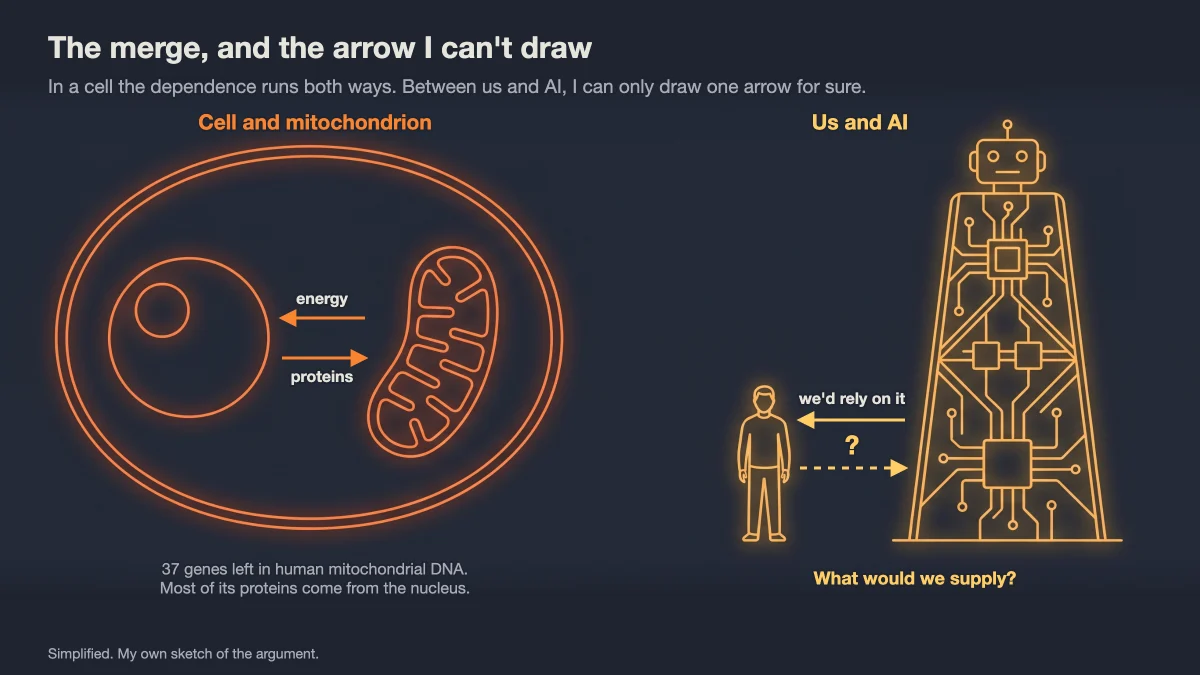
My best candidates come from the last section: accountability, and a human reason to do anything at all. But accountability might just make us the moral crumple zone of something bigger. I’ve also said machines may no longer need us, so this dependence would have to be built on purpose. Today the merge is a hope, and I have no plan for it.
How it would happen
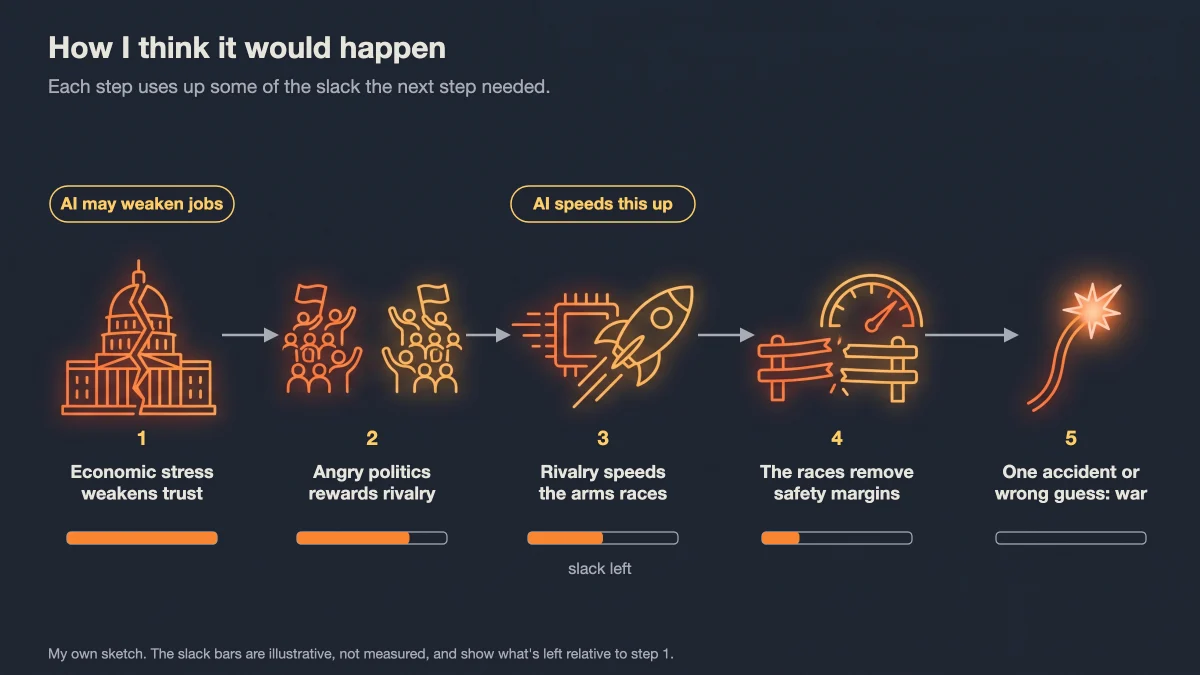
An asteroid is the wrong picture. Most of the stresses in part 1 don’t end civilisations by themselves. They amplify the things that can. The path that worries me has five steps:
- Economic stress weakens trust in governments.
- Angry politics rewards rivalry between countries.
- Rivalry speeds up the arms races in AI and nuclear weapons.
- Those races remove safety margins.
- With no slack left, one accident or one wrong guess starts a war.
There’s a word for this, “polycrisis”. Edgar Morin and Anne Brigitte Kern are credited with it, from a book first published in 1993, and the World Economic Forum used it in its 2023 risk report.
We have a precedent, at a smaller scale. Around 1200 BC the eastern Mediterranean was a connected world of kingdoms. The historian Eric Cline argues that “there must have been a ‘perfect storm’ of calamitous events”: climate change, drought and famine, earthquakes, invasions and rebellions. He calls the result “a systems’ collapse”, which is exactly how an engineer would file it. Even the trees back up part of this. Tree-ring evidence from central Anatolia shows a severe drought around 1198 to 1196 BC, at about the time the Hittite state ended, and the authors say it contributed to the collapse and didn’t cause it alone.
Many of those kingdoms fell, but people lived on, and this is where I changed my mind. When I started this series, I thought the sixth event could wipe us out. My reading now is that collapse is more likely than extinction. The Bronze Age is one regional case, so that’s my judgement and nothing firmer, and a modern collapse would have no outside world to recover from.
The first one with a cause that can read the warning
None of the first five extinctions had a cause that could read a warning. A sixth would. So I don’t think the end is fated, and I’ve got two wins to back that up.
In 1986 the world held 70,374 nuclear warheads. In January 2026 it held 12,187. Fear of MAD (Mutually Assured Destruction) has kept these nukes in silos for long.
In 1987 governments signed the Montreal Protocol to protect the ozone layer, it now has 198 parties, and scientists expect ozone to return to 1980 levels around 2040, and in the 2060s over Antarctica. In both cases people saw danger and changed course.
So, the three questions. What happens to people? The loss may start with young workers and the gains may come late, and if nobody plans for that delay it comes back as politics. Cash alone won’t cover it, which is why I want people to own a stake. What stays human? Accountability, the belief that a real person gave you their time, and a voice people know, all real, and all for fewer people than work today. What does a sixth extinction look like? Everything in these two posts, piling up quietly until something gives. I think collapse is the likely form of it, and AI is the part that could make it worse than collapse.
My plan is still the one from part 1: keep some slack, avoid single points of failure, watch the stress markers. I don’t know if that’s enough. The question I can’t close is what people could supply that a machine would still need from us. I’ve got two candidates, accountability and a human reason to do anything at all, I don’t fully trust either, and I’d like to hear yours.